
Commuting from New Jersey to Manhattan can be a great tradeoff for larger homes, good schools, and suburban life – if the trip to work is short and reliable. Several New Jersey towns fit the bill, offering fast trains, ferries or buses into New York City. Hudson River towns like Hoboken, Jersey City and Weehawken have rapid transit (PATH or ferry) and very short trips across the water. Essex and Union County suburbs such as Montclair, Maplewood, and Summit offer direct NJ Transit service (“Midtown Direct”) that can reach Penn Station in 35–45 minutes. Northern Bergen County towns like Ridgewood have longer train rides (often an hour or more), but many residents use express buses or drive via the George Washington Bridge in 30–45 minutes to midtown. Throughout these communities, housing is in high demand – home prices are generally above the NJ median (~$585K in 2025) – but the payoff is more space and often better schools.
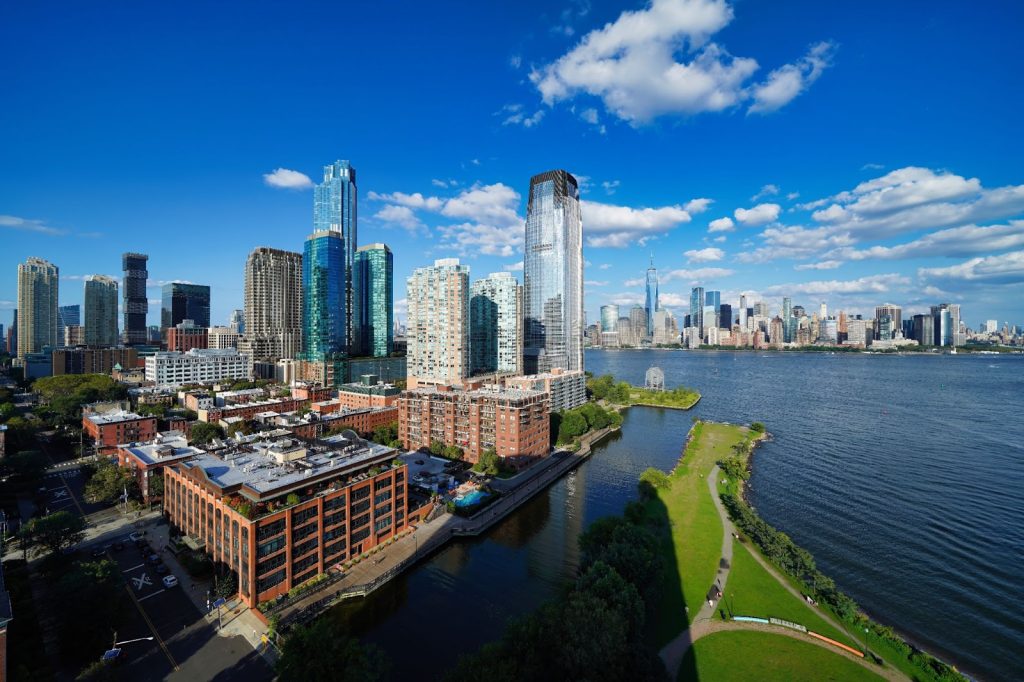
Hudson Riverfront living in Hoboken: Parks, cafes and ferries line the waterfront with stunning Manhattan views. Hoboken (pictured) combines a tight-knit, small-city vibe with unbeatable transit: PATH trains deliver riders to Lower Manhattan in about 11 minutes, and NYC-bound ferries (NY Waterway) take ~10–15 minutes to Midtown. PATH trains from nearby Jersey City reach Manhattan in ~15–20 minutes. Both cities have dozens of daily departures and relatively short waits. (Indeed, in 2025 NJ Transit touts that “PATH provides direct service… in 15–25 minutes” from Hoboken/Jersey City.) Ferries add backup options; NY Waterway markets its service as “fast, frequent & reliable” even during bad weather.
Hoboken and Jersey City also have vibrant urban lifestyles. Hoboken (avg. home value ~$818K) packs historic brownstones and restaurants into 1.9 sq mi of walkable streets. Locals praise Hoboken’s “tight-knit community” and relaxed small-town feel despite its proximity to Manhattan. Parks like Pier A and Sinatra Park offer green space and skyline views just steps from transit. In Jersey City, neighborhoods from Paulus Hook to Journal Square combine high-rise condos and townhouse blocks. Jersey City’s Liberty State Park and waterfront promenades give plenty of outdoor space, and downtown districts are filled with restaurants, art studios and tech offices. Home prices in Jersey City average ~$646K (condos can be cheaper), and the city has seen robust new development. Overall buyer demand is very high in both towns – inventory is tight (only a few dozen to a few hundred homes for sale) – reflecting their unrivaled commute convenience and rich amenities.
Weehawken, NJ: Just north of Hoboken lies Weehawken, a smaller town perched on a bluff overlooking Midtown Manhattan. Weehawken’s Lincoln Harbor and Port Imperial areas host luxury high-rise condos, many with garage parking (rare in Hoboken). Crucially for commuters, Weehawken has direct NY Waterway ferries to Midtown and the WTC; the trip to West 39th St. is only about 10 minutes. For example, from Port Imperial the ferry leaves every 10–15 minutes during rush hour, whisking riders to West 39th Street in roughly 12 minutes (NY Waterway schedules). There are also frequent NJ Transit buses through the Lincoln Tunnel (the #156/158 buses take about 15–20 minutes to Midtown in peak traffic). Home values in Weehawken are high (avg. ~$851K) since much of the housing stock is new or waterfront. The lifestyle here is quieter than Hoboken – think waterfront parks (Lincoln Harbor Marina, Weehawken Recreation Park) and river vistas rather than dense nightlife – but with easy city access. Demand is high: only about 50–60 homes were on the market in late 2025. Affordability is an issue, though: many properties exceed $800K, so Weehawken suits buyers looking to trade up for views and commute time.

MONTCLAIR, NJ – CULTURAL SUBURB WITH MIDTOWN-DIRECT TRAINS
Montclair is a lively suburb about 12 miles west of NYC. It’s known for its artsy downtown, top-rated schools, and diverse housing (Victorians, tudors, condos). Importantly for commuters, Montclair is on NJ Transit’s Montclair-Boonton Line with direct service to New York Penn Station via Secaucus. In practice, trains from Montclair can reach NY Penn in roughly 35–45 minutes (many trains are Midtown-Direct via the Secaucus Junction transfer). (On weekends even, Montclair trains connect at Newark or Secaucus to a Penn Station train, totaling under 50 minutes.) As one local buyer’s guide notes, Montclair offers “one of the fastest and most convenient suburban commutes to Manhattan”.
Living in Montclair means rich local amenities. The town boasts multiple downtowns (Glen Ridge nearby), with boutiques, cafes, theaters and the Montclair Art Museum. It hosts events like Montclair Film Festival and numerous restaurants (Latin, Asian, American) reflecting its diversity. Montclair also has abundant parks (Brookdale Park, the Presby Memorial Iris Gardens) and a famously panoramic view from Eagle Rock. No wonder it’s “particularly popular with families seeking walkable downtown areas, arts and culture, and highly rated schools”. The average Montclair home value is about $1,105,834 (with upscale neighborhoods over $1.2M). Demand is very strong: Montclair often has only a few dozen homes on the market, and properties frequently go under contract in a couple of weeks. Though commute times are slightly longer than Hoboken’s, Montclair buyers happily trade a 40-minute train for scenic suburban character.
MAPLEWOOD, NJ – CHARMING “VILLAGE” WITH MIDTOWN RAILS
Just south of Montclair, Maplewood is another Essex County town prized by NYC commuters. Like Montclair, Maplewood lies on the Morris & Essex NJ Transit line. Trains from Maplewood reach NYC Penn Station in about 35–45 minutes – typically around 41 minutes end-to-end with no transfers. (Some Maplewood trains go to Hoboken Terminal instead, but many are Midtown-Direct.) During peak hours express trains have a few minutes, and one private shuttle (Boxcar) even offers door-to-door buses to Midtown. A real estate guide notes that Maplewood’s “direct NYC access” and station-adjacent neighborhoods make it “one of New Jersey’s most sought-after commuter towns”.
Maplewood’s lifestyle also draws buyers. Its village-like downtown has pedestrian-friendly shops and restaurants, including diverse cuisines and local breweries. Parks and community events (e.g. Memorial Day parade) foster a small-town feel, even as the train station bustles with commuters. The typical Maplewood home (often early-20th-century colonials on moderate lots) averages about $910,258. Buyer demand is very high – homes near the train sell quickly in spring and fall, and inventory is usually below 50 listings. Compared to Montclair, Maplewood is slightly more affordable (median ~ $600K per one realtor’s list), though prices have climbed steadily. Overall, Maplewood offers a blend of suburban charm and a fast 40-minute train ride that appeals to many city workers.
SUMMIT, NJ – UPSCALE SUBURB WITH EXPRESS MIDTOWN TRAINS
Summit is a small city in Union County (bordering Essex), known for its leafy streets and high-end homes. Commuters here ride NJ Transit’s Gladstone or Morris & Essex lines. Importantly, Summit has an express train to New York Penn Station that takes only about 35 minutes on weekdays. (Local trains with more stops run 40–45 minutes.) This one-seat ride is among the fastest from a suburb, rivaling Hoboken’s speed. Summit’s station even has a covered parking deck, catering to drive-and-ride commuters.
Summit’s well-to-do lifestyle matches its commute. Downtown Summit (2nd Avenue) has boutique shops and dining, and the town is filled with large colonial and Tudor homes on spacious lots. It boasts top-rated schools and parks like the 7-acre Reeves-Reed Arboretum. One review praises Summit as “upscale… with some of the state’s most prestigious neighborhoods and top-tier amenities”. Unsurprisingly, Summit’s housing is pricy: the average home value is about $1,281,821. Even with steep costs, Summit remains a seller’s market – inventory is low (around 45 homes for sale) and buyers compete for any new listing. For commuters, Summit is ideal if you want a quick suburban trip to midtown and a classic downtown community.
RIDGEWOOD, NJ – AFFLUENT BERGEN COUNTY WITH LONGER COMMUTE
Ridgewood lies in Bergen County’s southeastern corner, about 25 miles from NYC. It’s famous for its high-quality schools and picturesque downtown. But transit is slower: NJ Transit’s Main/Bergen County line from Ridgewood takes roughly 75 minutes to Penn Station (due to stops or transferring at Secaucus). During rush hour there is an express bus to Manhattan (via Route 4 to the GWB) that can reach the Port Authority in ~35–40 minutes by car. Still, most riders take the train and plan for about 1¼ hours each way.
Ridgewood’s tradeoff is space and neighborhood. It’s top-rated for families: tree-lined residential streets feature mostly single-family homes (colonials, Victorians) on large lots. Downtown East Ridgewood Avenue is consistently ranked among NJ’s best: it has boutiques, restaurants, and a historic movie theater. The average Ridgewood home is very expensive (around $1,174,052), reflecting its desirability. Buyers face stiff competition despite the long commute: inventory is tiny (under 40 homes for sale) and prices keep climbing. People moving here accept a longer train ride in exchange for excellent schools, safety, and a suburban lifestyle unmatched closer to the city.
| Town | Avg Home Price (2025) | Commute to Manhattan | Primary Mode | Buyer Demand |
| Hoboken | $818,175 | ~11 minutes | PATH train (WTC) & ferries | Very High |
| Jersey City | $646,545 | ~15–20 minutes | PATH train & ferries | High |
| Weehawken | $850,965 | ~10–30 minutes | Ferry & NJ Transit bus | Moderate–High |
| Montclair | $1,105,834 | ~35–40 minutes | NJ Transit (Morris & Essex line) | High |
| Maplewood | $910,258 | ~40–45 minutes | NJ Transit (Morris & Essex line) | High |
| Summit | $1,281,821 | ~35 minutes | NJ Transit (Gladstone/M&E) | High |
| Ridgewood | $1,174,052 | ~75 minutes | NJ Transit (Main Line) | High |
Note: Commute times are typical rush-hour travel to Midtown Manhattan (often measured to Penn Station or Midtown) and may vary by exact route or traffic. “Buyer Demand” is qualitative (based on market observations).
Commute Options & Reliability: New Jersey offers multiple transit modes for Manhattan. In addition to trains and ferries, express buses (e.g. from Fort Lee or Teaneck over the GWB) serve many Bergen/Passaic towns with 35–45 minute trips. Car commuting (via I-95/Holland Tunnel or GWB) can take 30–60+ minutes depending on distance and traffic; during rush hour, trains or ferries often outperform driving. In general, PATH and ferries are considered fairly reliable (NY Waterway reports frequent departures and shelter from traffic), whereas NJ Transit trains have had more delays historically. Importantly, improvements are underway: for example, in early 2025 PATH closed Hoboken station for safety upgrades as part of a $430M “PATH Forward” modernization. And by 2025 NJ Transit has added capacity and express schedules on many lines. Riders typically plan for a few extra minutes buffer, but overall the transit infrastructure makes daily Manhattan commutes feasible from these towns.
Housing Market & Affordability: All of the above towns have active real estate markets, driven by demand from NYC workers. Inventory is tight everywhere – for example, Hoboken had ~125 homes on the market in fall 2025, and Montclair only ~54 – meaning sellers hold most of the leverage. Prices tend to be well above the statewide median (roughly $585K as of 2025). Even Jersey City’s mid-$600Ks and Maplewood’s ~$910K are higher than average New Jersey. Ridgewood, Montclair and Summit average around $1.1–1.3 million, reflecting larger lots and premium homes. Affordability varies: more urban towns (Hoboken, JC) have some condos in the $500–800K range, whereas spacious single-family neighborhoods (Ridgewood, Summit) rarely have sales below $800K. Buyers should factor that competition is fierce; for example, many homes go under contract in weeks or even days of listing, especially in popular school districts or near transit.
Making the Choice: When deciding among these towns, consider your priorities. If every minute counts, Hoboken or Jersey City can give you Manhattan within 15 minutes and a bustling urban scene. If you prefer a suburban feel with top schools, towns like Montclair, Summit or Ridgewood deliver (at the cost of a 35–75 minute ride). Weehawken offers a compromise: serene riverfront living with a quick 10–15 minute ferry to midtown. Maplewood bridges city and suburb, with a 40-minute train and a tight-knit community. In every case, weigh the commute against housing budget and lifestyle preferences. Many commuters report that once settled, the extra home space and neighborhood lifestyle in New Jersey make the daily ride worthwhile. Just be prepared: the market is competitive, so working with a savvy local agent and visiting the town (and its transit stations) in person can help secure the right home.
For personalized assistance and expert insights, contact Alexander Proskurov at (732) 580-2120 or email alexpr@newjerseyresidence.com.
This is not intended as a solicitation if your property is already listed with another brokerage.
