
Princeton, NJ offers a robust luxury housing market supported by its prestigious university, strong local economy, and rich history. The town is highly desirable for its top-rated schools and cultural amenities, and single-family home prices here typically exceed $1 million. Demand for high-end homes is intense: in May 2024, properties over $2.5 million sold for an average of 108.3% of list price. By mid-2025, constrained supply drove average sale prices up 21% year-over-year, highlighting continued strong demand. For buyers and builders alike, understanding these market dynamics is crucial when navigating Princeton’s luxury market.
TOP NEIGHBORHOODS FOR LUXURY HOMES
Princeton is composed of diverse enclaves, each with its own character and architectural charm. Among the most exclusive is the Western Section, home to many grand historic residences near the university. Houses here range from classic brick Colonials to timber-framed manors, and prices often start in the mid-seven figures. Another storied enclave is Edgerstoune/Hun, west of downtown near the Hun School. This neighborhood (including Russell Estates) boasts spacious luxury homes and commanding views; it averages about $2.6 million per house. Ettl Farm is similarly upscale, with single-family homes on large lots surrounded by preserved woodlands, commonly priced at $1.8 million and higher.
Lakeside living is also a draw in Riverside/Jugtown, where historic homes and contemporary estates line Lake Carnegie. Residences here often boast scenic water views and private docks. Riverside combines traditional and modern styles, and its median listed price (around $950,000) belies a range: high-end lakefront mansions sell for well above $2 million. To the south, Princeton Ridge offers an enclave of newer custom homes amid woodlands by the D&R Canal and preserved parks. While Ridge homes can be smaller than those on the Western hills, they still command luxury pricing due to privacy and setting.
Other areas of note include Princeton North and Littlebrook. Princeton North (near Witherspoon Street) features smaller lots and a mix of homes and condos, with prices from the high $500,000’s up to $1 million. This growing neighborhood now has new shops and restaurants, appealing to buyers who want urban convenience. Littlebrook and nearby Princeton Junction (on the town’s northern edge) have more contemporary single-family homes and townhouses, attractive to commuters with direct trains to New York and Philadelphia. While these may not host the mega-estates of older sections, they represent some of Princeton’s newer luxury development.
INVESTMENT CONSIDERATIONS AND MARKET TRENDS
Princeton’s luxury market dynamics favor sellers. In 2025, Princeton led the region in sale prices; for every new listing, more than one home went under contract. Inventory of upscale homes is tight: new listings in May 2025 were about 40% below year-ago levels, yet pending sales remained strong. Luxury properties sell quickly: typical days on market for high-end listings are in the 30–50 range. For sellers, this means well-priced luxury estates often sell at or above list price. For buyers and investors, it underscores the importance of acting decisively and working with local experts to gain early notice of new opportunities.
From an investment perspective, Princeton is a solid long-term bet. The town’s desirability grounded in Princeton University, corporate research parks, and outstanding schools supports steady home value growth. Custom-built estates can offer extra equity: high-end custom homes typically appreciate faster than production homes. However, buyers must account for high carrying costs. Princeton’s property taxes are among the nation’s highest, and a new graduated “mansion tax” now adds up to 3.5% on sales above $2 million. Net of taxes, investors should factor these into their return calculations.
Supply constraints also shape investment. With little undeveloped land, new luxury inventory comes mostly from tear-downs and subdivisions. Modest older homes, especially near desirable areas, are often demolished for mansion-scale rebuilds. This trend adds fresh high-end homes to the market but also raises entry prices for large lots. Currently there is no major new suburban development of estates within Princeton; instead, updated homes and custom builds arise on existing lots, often significantly increasing property density and value.
ARCHITECTURAL STYLES AND DESIGN TRENDS
The architectural landscape of Princeton’s luxury homes is richly varied. Historic styles abound: classic Colonial and Georgian mansions (symmetrical brick facades, shuttered windows) are common in older sections of town. Many feature modernized interiors while preserving exterior character. Victorian and Queen Anne homes also contribute charm, featuring ornate woodwork, bay windows, and expansive porches that blend indoor and outdoor living.
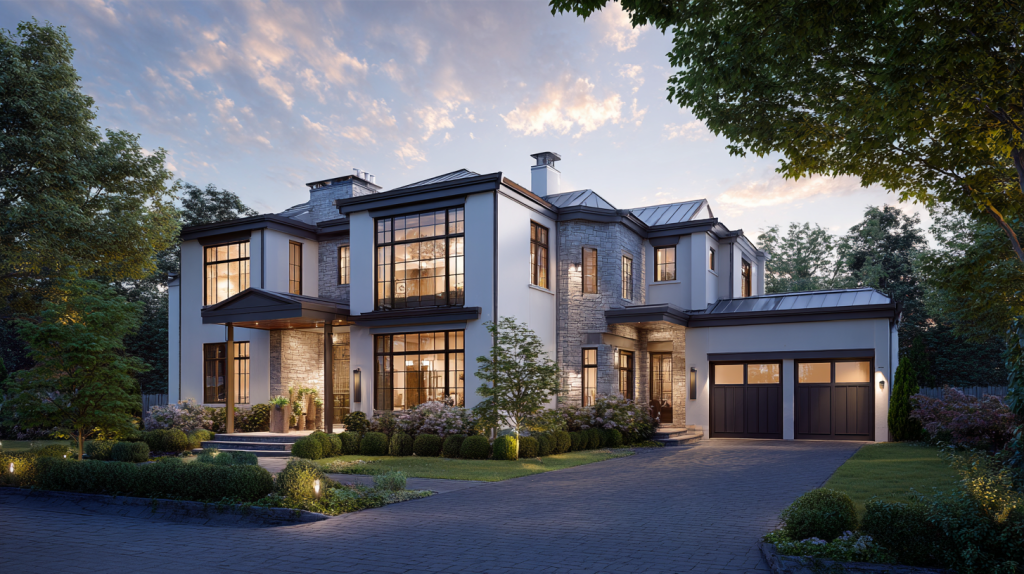
However, contemporary design is increasingly influential in new construction and renovations. Mid-century modern and contemporary homes are on the rise, characterized by open plans, minimalist lines, and abundant glazing. For instance, a recent renovation of a 1980s Colonial added floor-to-ceiling windows and extended wings to maximize Lake Carnegie views and natural light. Such projects highlight a trend: integrating the outdoors (e.g. lake or woodland vistas) with interiors. Sustainability is another priority. Princeton’s luxury clients frequently request energy-saving systems solar panels, geothermal heating, efficient HVAC and LED lighting to lower operating costs. Smart-home technology (automated lighting, security, climate control) is also common. Interior finishes skew toward high-end materials like stone, hardwoods, and custom millwork, complementing Princeton’s timeless aesthetic.
Local design preferences lean heavily toward quality and personalization. Luxury buyers typically engage architects and builders to tailor homes to their lifestyles. Projects often include bespoke elements: gourmet kitchens with professional-grade appliances, spa-like baths with saunas or showers, and dedicated home offices or gyms. Landscaping is likewise curated, with outdoor living spaces, lighting, and native plantings that suit the estate’s character. In sum, Princeton’s high-end real estate rewards craftsmanship and thoughtful design choices.
LOT AVAILABILITY AND ZONING
Large developable lots in Princeton are rare, reflecting the town’s historical settlement. Most of the municipality is already built out, so custom builders typically work on infill sites or subdivided parcels. As noted, tear-downs are a frequent source of new lots: replacing a small or outdated house with a luxury build is common in upscale neighborhoods. Securing an ideal building site often requires patience or being ready to move quickly when a property becomes available. Prime lakefront, stream-front, or bluff-top lots are especially scarce and command a premium.
Princeton’s zoning regulations further shape what can be built. In 2018, the merged municipality adopted Neighborhood Residential standards that apply across all residential zones. These rules reinforce character: for example, on most lot sizes the house and main entrance must face the street, with defined sidewalks and path connections. Bulk requirements are strict: in many districts the building height is capped at 35 feet (raising only to 40 feet for some attached units), and lot coverage limits were revised to balance open space with development. Architects must often design with setbacks, orientation, and scale in mind, which can limit very large homes on small parcels.
Navigating zoning is critical for builders. Projects with non-standard designs (such as very tall volumes or unconventional massing) may require variances, which entail public hearings. Builders often plan garages and accessory structures to meet the newer setback rules (garages frequently must face away from the street). Fortunately, the 2018 code relaxation of some coverage limits and height formulas means planners have slightly more leeway than before. Engaging a local architect or planner early is essential to streamline approvals.

BUYING VS. BUILDING: A COMPARATIVE OVERVIEW
When pursuing a luxury home in Princeton, buyers must decide between purchasing an existing estate or building from scratch. Both paths have distinct trade-offs. The table below summarizes key considerations:
| Factor | Buying an Existing Luxury Home | Building a Custom Estate |
| Timeframe | Move-in ready upon closing (typically days to weeks). | Long timeline (often 12–24 months or more to complete). |
| Upfront Cost | Purchase price is fixed; typically lower than new-build costs. | Higher overall outlay (land + custom design + construction; change orders raise costs). |
| Customization | Limited to existing layout; major features fixed (renovations needed to change structure). | Full control over floorplan, features, finishes, and orientation to maximize views and lifestyle. |
| Location Flexibility | Must choose from available listings; limited control over lot choice. | Can select an optimal lot (or tear-down site) in a desired neighborhood, if available. |
| Condition & Quality | May have older systems or deferred maintenance; inspections essential. | Brand-new construction with modern materials, energy-efficient systems, and warranties. |
| Permitting & Zoning | Zoning and approvals are already in place for the existing structure. | Subject to new permits and full zoning review; may need variances for special designs. |
| Value & Investment | Market value based on comparables; pricing reflects current location/history. | Potential for higher resale value from custom luxury specs; also carries risk of cost overruns. |
| Design Involvement | Mostly passive: select a finished home. Any upgrades are additional. | Highly hands-on: buyer collaborates with architect and builder on every decision. |
This comparison highlights that buying allows quick occupancy without construction complexity, whereas building custom offers a fully tailored home at the price of time and project management. In Princeton’s context, buyers who want immediate luxury and fewer unknowns may favor existing estates, while those seeking an entirely unique residence often choose to build (provided they secure a suitable lot). Both strategies can produce a dream home, but each requires aligning with trusted professionals and realistic budgeting.

SHAPING TOMORROW’S LUXURY LANDSCAPE IN PRINCETON
The Princeton luxury market is strong, highly competitive, and shaped by local character. It is, as one local summary notes, “a vibrant and unique city with a wide variety of neighborhoods” and “beautiful neighborhoods in Princeton” backed by “excellent schools [and] a robust economy”. Whether buying a grand mansion in an established enclave or commissioning a custom estate on a rare parcel, success depends on careful planning and expert guidance. Working closely with knowledgeable local professionals top realtors, architects, and builders ensures that every aspect (from neighborhood choice to design to permitting) is handled wisely. With the right team and strategy, a buyer can secure ownership of a premier estate and fully capitalize on this exceptional New Jersey market.