
Princeton, New Jersey, occupies a rare position in the Northeast real estate landscape. Defined by academic prestige, architectural heritage, and constrained land supply, the town consistently commands premium property values across both historic and newly constructed residences. In this highly competitive environment, a distinct investment strategy has gained momentum among luxury buyers and developers alike: acquiring older homes primarily for their land value and redeveloping the site with a new custom estate. Commonly referred to as a teardown strategy, this approach is reshaping several Princeton neighborhoods and redefining price ceilings across micro-markets.
The teardown model is not merely about demolishing an outdated structure. It is fundamentally a land-value play rooted in scarcity economics. Princeton’s inventory of buildable parcels is extremely limited. In many of the town’s most desirable areas, there are virtually no vacant lots available. As a result, buyers seeking privacy, modern layouts, and estate-level amenities increasingly look toward older properties situated on prime parcels. By purchasing an aging home and replacing it with a newly constructed residence, investors and end-users can unlock value that far exceeds the condition-adjusted worth of the original structure.
Yet the teardown decision is far from simple. It involves analyzing land pricing, construction budgets, zoning constraints, neighborhood comparables, resale psychology, and long-term appreciation trends. When executed correctly, the strategy can generate substantial equity creation. When miscalculated, it can compress margins and extend timelines. Understanding when a teardown makes financial and strategic sense in Princeton requires a deep examination of local market dynamics.

PRINCETON’S LAND SCARCITY AND PRICE COMPRESSION
One of the primary drivers behind teardown activity is land scarcity. Princeton is largely built-out, meaning that horizontal expansion opportunities are limited. Strict zoning regulations, environmental protections, and historic preservation overlays further constrain new subdivision development. This creates upward pressure on land values, particularly in established luxury neighborhoods.
In prime locations such as Princeton Ridge and areas near downtown Princeton, lot size often matters more than the existing structure. A dated 1950s home on a two-acre parcel may trade at a price that reflects its redevelopment potential rather than its architectural merit. In these transactions, the home is effectively valued as a placeholder, while the underlying land becomes the true asset.
Over the past decade, this compression between structure value and land value has intensified. Buyers are willing to pay premiums for location certainty, school access, privacy, and proximity to Princeton’s cultural core. When the land component represents the majority of the acquisition price, the teardown strategy becomes a rational economic decision rather than an aesthetic one.
BUYER PSYCHOLOGY: WHY CUSTOM ESTATES OUTPERFORM RENOVATIONS
Luxury buyers in Princeton increasingly prefer fully customized homes designed around contemporary living standards. Open floor plans, integrated indoor-outdoor living, energy-efficient systems, smart home technology, wellness spaces, and resort-style amenities are often difficult to retrofit into older structures without structural compromises.
While high-end renovations remain viable in certain historic districts, full rebuilds frequently provide superior design flexibility. A teardown enables architects and builders to optimize orientation, maximize square footage within zoning limits, elevate ceiling heights, and incorporate modern materials without the constraints of legacy layouts.
From a resale perspective, newly built custom homes typically command stronger price-per-square-foot metrics compared to renovated mid-century homes of similar size. Buyers perceive new construction as lower maintenance, technologically advanced, and aligned with current design preferences. This perception supports premium resale pricing and contributes to stronger long-term appreciation.
ZONING, SETBACKS, AND DEVELOPMENT PARAMETERS
Teardown feasibility in Princeton is heavily influenced by zoning regulations. Lot coverage limits, building height restrictions, setback requirements, and historic district guidelines can all affect the scale of redevelopment. In some neighborhoods, demolition approval may require additional review processes, particularly when properties possess architectural or cultural significance.
Understanding allowable buildable envelope size is critical. Investors must calculate whether the lot can support the intended square footage necessary to justify total project costs. For example, a buyer acquiring a $2.5 million property for land value must ensure that the new home can achieve a resale value significantly above combined acquisition and construction costs.
Setback constraints also influence design potential. Wider lots with generous frontage allow for grander façades and more expansive floor plans. Irregularly shaped parcels or environmentally sensitive lots may limit redevelopment scope and compress profit margins. Early collaboration with land use attorneys, architects, and local planning professionals is essential to mitigate entitlement risk.
CONSTRUCTION COSTS AND BUDGET SENSITIVITY
Custom estate construction in Princeton sits at the upper end of New Jersey’s pricing spectrum. High-end builds incorporating luxury finishes, advanced mechanical systems, premium landscaping, and bespoke architectural detailing can range significantly depending on size and complexity.
Construction budgets must account not only for vertical building costs but also for demolition, site preparation, engineering, architectural design, permitting, utility upgrades, driveway reconstruction, and high-end landscaping. Underestimating soft costs can materially impact overall project returns.
Budget sensitivity becomes especially important during periods of fluctuating material pricing or labor shortages. A teardown project that initially pencils with a comfortable margin can quickly compress if construction costs escalate unexpectedly. Therefore, conservative underwriting and contingency reserves are critical components of successful redevelopment planning.
MICRO-MARKET PERFORMANCE: WHERE TEARDOWNS MAKE THE MOST SENSE
Teardown economics vary significantly by neighborhood. Prime estate zones such as Princeton Ridge consistently support large custom homes with strong resale demand. The combination of privacy, wooded landscapes, and proximity to town enhances value stability.
Areas closer to the Historic Borough may involve stricter architectural review, yet they benefit from exceptional walkability and prestige. In such micro-markets, newly constructed homes that respect contextual design while incorporating modern interiors can achieve record-setting prices.
Peripheral areas such as Montgomery Township or West Windsor may offer lower land acquisition costs, but resale ceilings can differ. Investors must carefully evaluate whether end-value comparables support the scale of construction being contemplated. Building significantly above neighborhood norms can increase marketing time and reduce liquidity.
FINANCIAL MODELING: BREAKING DOWN A TYPICAL TEARDOWN SCENARIO
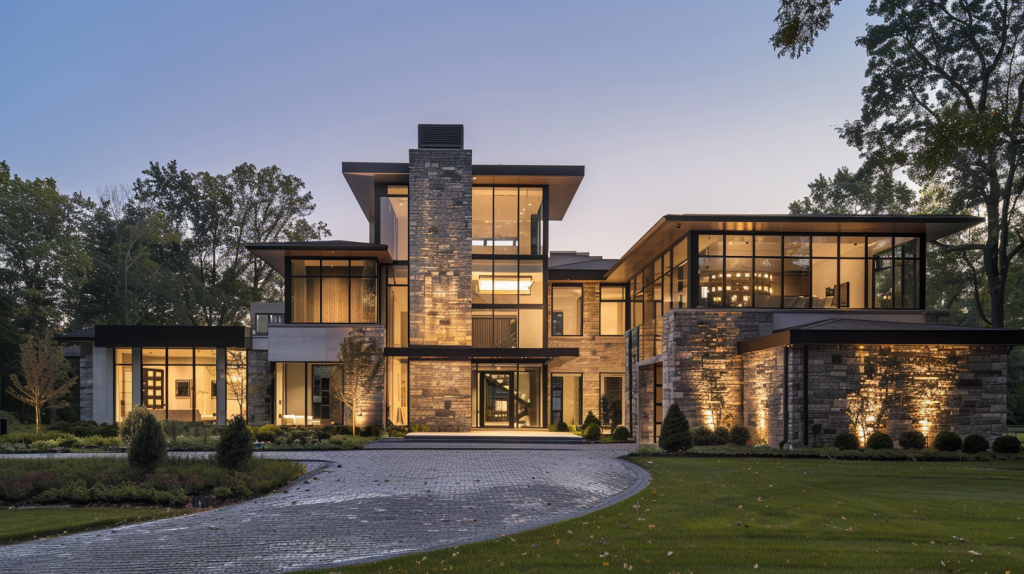
A simplified financial model illustrates teardown logic. Consider a property purchased for $2.2 million primarily for its land. Demolition and site preparation may total $150,000. Construction of a 7,000-square-foot custom estate could range between $2.5 million and $3.5 million depending on finish level and architectural complexity.
Total project basis may fall between $4.85 million and $5.85 million. If comparable new construction homes in the same micro-market trade between $6.5 million and $7.5 million, the investor captures meaningful equity upside while also enjoying long-term appreciation potential.
However, if resale ceilings sit closer to $5.5 million, margin compression becomes a risk. Accurate comparative market analysis and conservative exit assumptions are essential.
COMPARATIVE TABLE: TEARDOWN VS. HIGH-END RENOVATION
| Category | Teardown Strategy | High-End Renovation |
|---|---|---|
| Design Flexibility | Full customization | Limited by existing structure |
| Construction Timeline | Longer, more complex | Shorter but potentially unpredictable |
| Initial Cost | Higher overall investment | Lower upfront but renovation risk |
| Resale Premium | Often higher for new builds | Moderate depending on scope |
| Zoning Constraints | Must meet new code | May benefit from grandfathered elements |
| Long-Term Maintenance | Lower due to new systems | Potential hidden legacy issues |
| Architectural Impact | Redefines neighborhood ceiling | Preserves original character |
RISK FACTORS AND MITIGATION STRATEGIES
Despite strong potential, teardown projects carry risks. Regulatory delays, construction overruns, financing shifts, and market softening can all impact profitability. Princeton’s luxury segment has historically demonstrated resilience, yet no market is immune to macroeconomic fluctuations.
Mitigation strategies include locking construction pricing where possible, phasing landscaping investments, maintaining liquidity reserves, and selecting architects with local entitlement experience. Partnering with builders familiar with Princeton’s permitting process can significantly reduce timeline uncertainty.
LONG-TERM APPRECIATION AND LEGACY VALUE
Many teardown buyers in Princeton are not purely speculative investors. They are end-users seeking legacy properties designed for multi-generational living. In such cases, financial modeling includes both lifestyle return and investment performance.
Custom estates built to high sustainability standards, incorporating geothermal systems, energy-efficient envelopes, and durable materials, often outperform in resale scenarios. They also align with evolving buyer expectations emphasizing wellness, efficiency, and technological integration.
Land value appreciation tends to anchor long-term performance. Even if construction margins fluctuate, the underlying land in high-demand Princeton neighborhoods has historically supported upward pricing trends due to limited supply and enduring demand drivers.
MARKET OUTLOOK: WILL TEARDOWNS CONTINUE?
Given Princeton’s constrained land availability, consistent buyer demand, and preference for modern luxury, teardown activity is likely to remain a defining feature of the market. As older housing stock ages and affluent buyers seek personalization, redevelopment will continue to reset pricing benchmarks.
However, increasing scrutiny around neighborhood character preservation may influence design guidelines in certain districts. Future redevelopment will likely balance architectural compatibility with innovation.
The economic viability of teardowns ultimately rests on disciplined acquisition pricing and realistic construction budgeting. When land is purchased at a rational basis and redevelopment aligns with neighborhood resale ceilings, the strategy can generate substantial wealth creation.
WHEN DOES A TEARDOWN MAKE SENSE IN PRINCETON?
A teardown makes sense in Princeton when land value justifies redevelopment, zoning allows meaningful scale, construction budgets are conservatively underwritten, and resale comparables support the projected end value. It is not simply a demolition decision but a strategic capital allocation move grounded in location scarcity and long-term appreciation dynamics.
For buyers seeking personalized estates and investors targeting equity creation, teardown projects represent one of the most powerful mechanisms for unlocking value in Princeton’s luxury real estate market. When approached with analytical discipline and local expertise, the strategy transforms aging properties into architectural statements that redefine neighborhood benchmarks and solidify long-term asset performance.