
In recent years, New Jersey’s housing market has been influenced not just by macroeconomic factors—interest rates, supply shortages, property taxes—but also by shifting generational preferences. Millennials (born roughly 1981–1996) and Generation Z (roughly 1997–2012) are now in key life stages: forming households, starting families, seeking affordability, and expecting certain amenities. Their tastes and constraints are reshaping what kinds of homes are in demand, what neighborhoods are popular, and what sellers can expect when listing properties.
This report explores these changes in depth. We examine current data on what Millennials and Gen Z want in New Jersey homes, how their preferences differ from older generations, what challenges they face, and how that affects homeowners considering selling. If you’re thinking about putting your home on the market in New Jersey, understanding these trends is essential.
THE CURRENT STATE OF THE NEW JERSEY HOUSING MARKET (2025)
To understand how Millennials and Gen Z are influencing demand, one must first grasp the baseline of the New Jersey market as of mid-2025.
- Inventory & Supply: Housing inventory remains constrained. Homes for sale are fewer relative to demand, especially in desirable suburban and transit-accessible areas.
- Prices: The median home price in New Jersey has continued to rise, though growth rates have moderated compared to pandemic years. High-price counties (e.g. Bergen, Essex) show stronger price levels, while some southern counties remain relatively more affordable.
- Interest Rates: Mortgage interest rates remain elevated (somewhere in the region of ~6.5% for many buyers), which adds cost pressure for buyers with smaller budgets.
- Market Sentiment: Buying activity is steady. Sellers in many cases still have leverage in strong school district zones or transit-accessible suburbs. On the other hand, bidding wars have cooled somewhat compared to the peak, and some buyers are more cautious.
WHO ARE MILLENNIALS & GENERATION Z IN NEW JERSEY?
Understanding demographic and economic profiles of these generations helps clarify their housing behavior.
| Characteristic | Millennials (1981-1996) | Gen Z (1997-2012) |
| Typical age in 2025 | ~29-44 years old | ~13-28 years old (many just entering workforce / early adulthood) |
| Income & career stage | Many established in careers, dual incomes, some raising families, more financial obligations (student loans, child care) | Many early in careers or finishing education, smaller savings, more sensitive to entry-costs |
| Household formation | Buying first or second homes; married or partnering; interest in families, safety, schools | First-time buyers; renting more; smaller households; often more flexibility, delay in full purchase until affordability allows |
WHAT MILLENNIALS & GEN Z WANT: EVOLVING PREFERENCES
Several trends in preferences distinguish Millennials and Gen Z from prior generations. These are particularly relevant in New Jersey, where location, cost, and amenities matter very much.
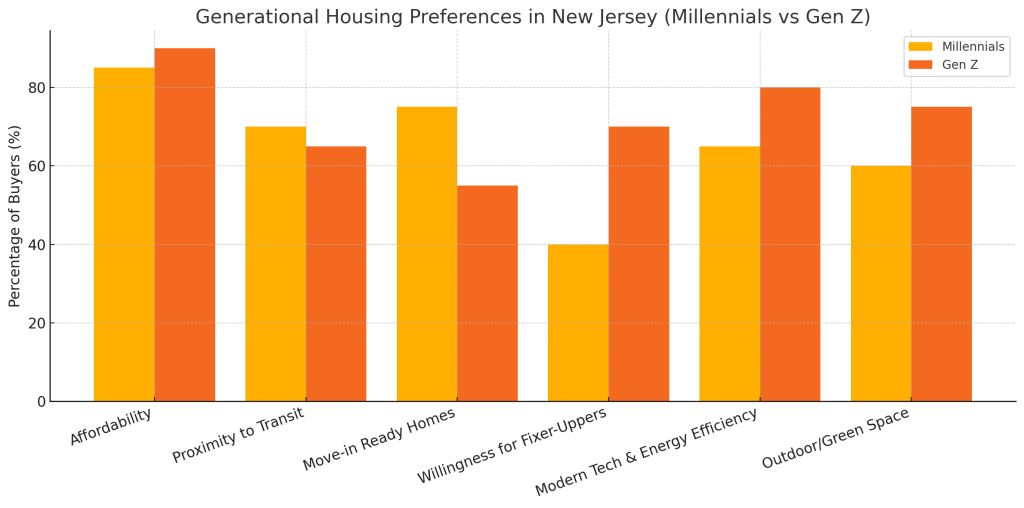
- Affordability & Budget Constraints
Many younger buyers are priced out if home prices and property taxes are too high. This especially impacts those in Bergen, Essex, and Monmouth counties, pushing demand toward more affordable counties or suburbs further from major job hubs.
Gen Z, in particular, display high sensitivity to down payments, interest rates, monthly carrying cost. Some are willing to compromise on size or condition if the price is right.
- Proximity to Transit, Commuting Concerns
Millennials, having grown up in densely connected areas, often prefer homes with access to public transit or reasonable commuting time to employment centers (New York City, Newark, or other hubs). Suburban towns with train or bus access are in high demand.
Gen Z similarly value commute time and remote or hybrid work arrangements. The ability to work from home (or part-time) factors into what neighborhoods are considered.
- Smaller Homes; Flex Space & Multi-use Rooms
Both generations show interest in homes that allow flexibility: home offices, gym or studio space, open floorplans. Especially for Gen Z, who often begin with more modest budgets, these flex spaces may substitute for sheer size.
Older Millennials tend to look for family-friendly features: multiple bedrooms, outdoor space, safe neighborhoods, good schools.
- Condition vs Potential
A noticeable number of Gen Z buyers are open to fixer-uppers – homes needing renovation or updating – if the purchase price allows for total cost to stay within budget.
Millennials are more mixed: many prefer move-in ready homes especially if family duties or work leave less time for DIY. However, in higher-price counties or for premium homes, finish and quality still carry premium value.
- Amenities, Lifestyle & Technology
Modern kitchens, energy efficiency, smart home features, good internet connectivity, modern HVAC, open floor plans are more expected, not just optional.
Outdoor living space, green space, walkability, access to recreation are more valued. Younger generations often trade off size for lifestyle features (parks, trails, cafes, local shops).
- Sustainability & Costs of Ownership
Property taxes in New Jersey are among the highest in the U.S., which is a major concern. Buyers are asking about taxes, energy bills, maintenance. Homes with lower maintenance, lower utility costs, or with features like solar panels may become more appealing.
Mortgage product types matter: adjustable-rate mortgages (ARMs) may be used by some with expectation rates will drop; others prefer fixed rate even at higher current cost to avoid risk.
KEY CHALLENGES & CONSTRAINTS FOR YOUNGER GENERATIONS
While preferences are shifting, Millennials and Gen Z still face several major hurdles in New Jersey.
High Home Prices & Property Taxes: Even outside the most expensive counties, prices compared to income are challenging. High property taxes amplify monthly commitment.
Interest Rates: Elevated mortgage rates reduce buying power. Even modest differences in rate can significantly change monthly payments.
Limited Inventory: For homes meeting both the price point and amenity/location demands, supply is thin. Good school districts, transit access homes are especially in short supply.
Affordability Gap: Down payment savings, closing costs, and maintenance expenses are still barriers. Student debt burdens weigh heavier on younger buyers.
Competition: In desirable towns and suburbs, multiple offers can still occur, driving prices beyond reasonable levels for many.

HOW THESE TRENDS ARE SHAPING DEMAND IN NEW JERSEY BY REGION
Not every county or city in New Jersey is experiencing these shifts in identical fashion. Below is a breakdown by region or type of location, illustrating how generational preference is altering demand.
| Region / Type | What Millennials & Gen Z Prefer Here | Effects on Demand & Home Values |
| Northeast NJ / Bergen, Essex, Hudson | Close to transit, walkable neighborhoods, smaller homes with modern finishes, condos/townhouses rather than large detached homes | Strong competition; homes that lack modern features or have poor transit access are less attractive; premium paid for desirable areas |
| Central / Middlesex / Monmouth | Balanced commute, newer subdivisions, newer or renovated homes, outdoor space, quality schools | Demand rising; those areas with both transit access and more space are getting more attention and price growth |
| Southern & Rural NJ | More affordable price, more land, willingness to settle a longer commute if the property offers value and condition | Slower price growth than metro suburbs but increasing pressure as buyers reach budget limit; more interest in leave-the-city value propositions |
| Urban centers (Jersey City, Hoboken, Newark, etc.) | Condos, minimal maintenance, lifestyle amenities, walkability, shared amenities (gyms, communal spaces), proximity to nightlife / services | High price per square foot; markets segment into high-end vs more modest units; new construction tends to favor luxury amenities in these areas |
IMPLICATIONS FOR SELLERS IN NEW JERSEY
For homeowners considering selling in this climate, these trends suggest several strategies and considerations.
- Upgrade Wisely
Homes that are outdated or lacking modern features may lose value or receive fewer offers. Key upgrades might include kitchen/bathroom improvements, energy efficiency (insulation, windows), smart home systems, and outdoor space beautification. But over-improving relative to neighborhood norms may not yield proportional return. - Focus on Presentation & Amenities
Because Millennials and Gen Z often conduct much of their search online first, properties with high-quality photos, virtual tours, modern staging, appeal to lifestyle (walking, outdoor space, commute time) get more traction. - Price Strategically
Given affordability constraints, pricing that reflects the buyer’s perceived value (taking into account taxes, commute, condition) can make a difference. An overpriced home in a strong school district may still sell, but overpriced in a marginal location or with deferred maintenance will struggle. - Market Location Advantages
Sellers whose homes are near transit, good schools, local commerce, or have walkability & green space should emphasize these features heavily. These are increasingly non-negotiable for many younger homebuyers. - Plan Timing
The Spring and Summer markets remain more active in New Jersey. But some sellers may benefit from listing in late Summer or early Fall when competition among listings is lower, leading to potentially more motivated buyers. Given interest rates and uncertainty, some buyers may be waiting for market conditions to improve, so timing matters.
GENERATIONAL HOMEOWNERSHIP RATES & TRENDS
Here’s a detailed table summarizing some recent data (2024-2025) on homeownership & market behavior of Millennials and Gen Z, relevant to New Jersey or U.S. more broadly, as a frame of reference:
| Metric | U.S. / National Data | Implications for New Jersey |
| Homeownership Rate – Gen Z | ~26.1% owned their home in 2024 (flat vs prior years). | Suggests many Gen Z in NJ are still renters, or saving, not yet entering the full purchase market. High costs and taxes likely delay ownership. |
| Homeownership Rate – Millennials | ~54.9% in 2024. | Many Millennials in NJ likely already own or are in process; second home / upsizing trends among this cohort. |
| What Millennials Care About Most | Affordability is the top factor (about 44% of Millennials say it matters most), tied often with location. | In NJ, high property taxes and high home prices make “affordability” a paramount concern; proximity to employment centers heavily weighted. |
| Gen Z Attitudes | Many Gen Z plan to buy in 2025 (~67% in one survey) but many are cautious, delaying if rates or prices seem unfavorable. | In NJ, that means demand may grow if rates drop or affordable inventory increases; until then, many Gen Z households rent or stay in prior living situations. |
| Flatlined Growth of Ownership Rates | Gen Z and Millennials homeownership rates fairly stable recently, growth slower due to cost pressures. | Suggests that for home sellers, there may not be explosive growth of buyer pool, but a steady stream—some pent-up demand. |
WHAT THIS MEANS FOR THE FUTURE MARKET IN NEW JERSEY
Given these preferences and constraints, what likely trajectories are shaping up in New Jersey housing for the next few years?
- Continued Pressure on Suburbs & Transit-friendly Areas: Suburban towns with good transit connections, strong schools, and amenities will likely see price appreciation continue. Sellers there may be in particularly strong positions.
- Growing Demand for Smaller, Efficient Homes: Homes that deliver good value per square foot—flex space instead of super large lots, efficient design, lower maintenance—will become more valued among these generations.
- Hybrid & Remote Work’s Influence: Gen Z and many Millennials work remotely or in hybrid mode. This means some will accept longer commutes if the home allows remote work, or prioritize homes with dedicated office or workspace. Regions a bit further from city centers but with good connectivity may see gaining popularity.
- Policy & Housing Supply Response: To meet the demand of younger buyers, local government, developers, and planners may need to focus more on affordable housing units, inclusionary zoning, and easing of regulatory / permitting processes to get more supply online. New Jersey has in recent forecasting acknowledged needs for 60,000-80,000 affordable housing units.
- Interest Rates & Mortgage Products Will Be Key Variables: If mortgage rates decline, demand may surge. But many younger buyers seem cautious about locking into too high of a rate. Adjustable-rate mortgages, refinancing options, or subsidies could influence how quickly demand materializes.
PRACTICAL ADVICE FOR HOMEOWNERS CONSIDERING SELLING
For someone in New Jersey thinking about selling, given these generational shifts:
- Evaluate Your Home’s Appeal to Younger Buyers
Think: Would a Millennial or Gen Z buyer find my home attractive? Consider location (commuting, walkability), condition, modern features, outdoor space, digital connectivity. If lacking, modest investments could increase appeal and sellability. - Adjust Expectations Around Pricing & Timeline
Homes may still fetch good prices, especially in desirable neighborhoods. But unrealistic prices or outdated properties may linger on the market. Be prepared for negotiations, and ensure that listing price reflects what comparable homes with “Millennial/Gen Z values” are going for. - Marketing Matters Differently
Use high-quality photography and virtual tours; emphasize amenities often overlooked in older listings (efficient heating/cooling, office space, internet connectivity, transit options, local amenities). Highlight costs (property taxes, utility bills) clearly, since younger buyers are cost-sensitive. Consider online/social media marketing channels more heavily than past. Even for local property sales, Instagram, TikTok, Zillow, etc., influence younger buyer behavior. - Timing & Seasonality
While traditional selling seasons remain useful, paying attention to economic signals (interest rate trends, inventory levels) may allow sellers to choose windows when buyer demand is stronger. Sometimes early Spring or late Summer/Fall windows may be less competitive for listings, giving listings greater visibility. - Consider Seller-Assisted Improvements or Incentives
To bridge gaps, sellers could offer minor renovations, flexible closing dates, or other incentives appealing to younger/first‐time buyers (e.g., offering to cover closing costs, warranty for systems, etc.).
RISKS & WHAT COULD GO AWRY
No trend is without potential obstacles. These are some of the risks in New Jersey’s market given the generational shifts:
- If interest rates rise or stay high, affordability could worsen, suppressing demand.
- Inflation in construction and labor costs could make renovations or upgrades costlier, reducing the return on improvements.
- Property tax pressures or utility cost increases could dampen buyer enthusiasm or shift preference towards smaller or more efficient homes.
- If supply of affordable homes does not increase, the “price barrier” may push more younger people to remain renters or relocate outside New Jersey.
- In areas without good infrastructure, transit, or amenities, homes may see less demand even if price is lower—buyers are increasingly valuing lifestyle factors, so location and neighborhood quality count more than before.
SUMMARY & OUTLOOK
Millennials and Generation Z are now major forces shaping New Jersey’s housing market. Their preferences—affordability, transit access, modern features, flexible space, and sustainability—are shifting what desirability looks like. While older generations and often sellers have focused on size, lots, and perhaps location alone, these younger generations demand more nuance in condition, functionality, and cost of ownership.
For homeowners in New Jersey thinking about selling, the message is: adapt to what buyers now prioritize. Homes that meet modern expectations of convenience, style, and cost will have greater appeal. Homes that lag behind in these respects may require upgrades or clever marketing to avoid stagnation. The supply side—developers, local governments, planners—will also play a critical role in whether demand from younger generations can be met sustainably.
If trends continue, we can expect modest price growth focused particularly in suburbs and transit-friendly towns, increasing interest in smaller, efficient homes, and more competition for homes that deliver strong value in terms of amenities, location, and cost.
New Jersey’s real estate market in 2025 is in a phase of generational transition. Millennials, many now in their prime earning and homeowning years, and Gen Z, entering homeownership under challenging economic conditions, are redefining what buyers expect. Homes that once sold based purely on location or size no longer suffice; cost of ownership, condition, flexibility, and lifestyle carry increasing weight.
For sellers, this means aligning with these priorities: investing in the right upgrades, pricing with sensitivity to affordability, marketing toward younger buyers, and selling when conditions favor demand. For buyers, especially Millennials and Gen Z, awareness of their own constraints (rates, down payment, taxes) and patience may be rewarded as the market adjusts.
The future of New Jersey’s housing market will be shaped by how well supply, financing, and policy respond to these generational preferences. Homes built or upgraded with younger generations in mind will lead the way; others must pivot or risk being left behind.
For personalized assistance and expert insights, contact Alexander Proskurov at (732) 580-2120 or email alexpr@newjerseyresidence.com.
This is not intended as a solicitation if your property is already listed with another brokerage.
