
Many homebuyers and families find New Jersey’s suburban lifestyle, housing costs, and community amenities very appealing compared to New York. This is especially true for those seeking single-family homes: New Jersey offers more space (yards, driveways, etc.) and diverse neighborhoods within commuting distance of major cities. In mid-2025, statewide data show that median home prices in New Jersey are in the mid-$500,000s, roughly in line with New York’s statewide. Crucially, though, New Jersey buyers often get larger homes (and yards) for their money. For example, affluent New Jersey suburbs have very high prices – Montclair’s median home is about $1.35 M, and Princeton’s median is about $961 k – but these communities offer big houses and top-rated schools. Even urban Jersey City’s typical home sells for around $768 k, generally lower than comparable Manhattan-area homes. In short, New Jersey buyers can often afford a larger single-family home on a suburban lot, whereas buyers with the same budget in New York (especially in NYC or its close suburbs) would get less space or a condominium.
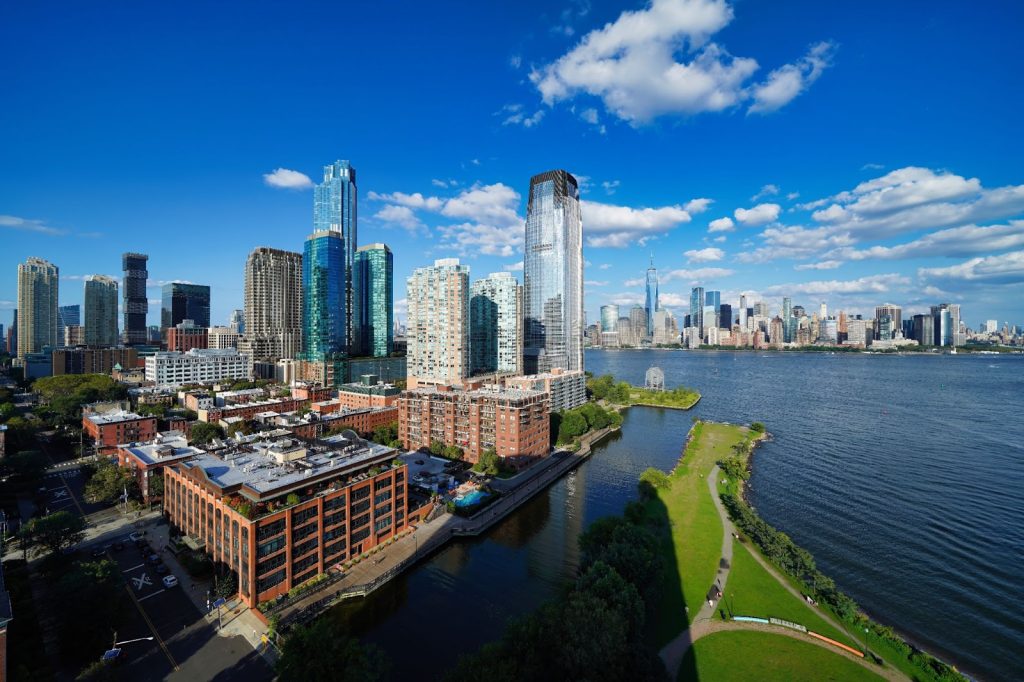
| Metric | New Jersey | New York |
| Median Home Price (2025) | $545,400 | $481,264 |
| Median Annual Property Tax | $8,290 | $3,946 |
| Avg. Commute Time (minutes) | 30.9 | 32.8 |
HOUSING AFFORDABILITY AND MARKET TRENDS
For single-family buyers, New Jersey often feels more “affordable” per square foot than New York. Statewide median home values in NJ ($569k average value) are comparable to New York’s ($509k average by Zillow’s measure), but New Jersey’s housing stock is more suburban – buyers typically get larger detached houses instead of small city lots or co-op apartments. In fact, the New Jersey market remains very competitive: as of mid-2025 Redfin found the statewide median sale price at $578,800 (all home types), up about 4% year-over-year. In New York (statewide), the median was even higher, $596,500 (up 6.4%), reflecting New York City’s influence on the state average.
This means that homes in New Jersey and New York cost roughly the same on paper, but New Jersey buyers usually get more houses for the money. For example, Montclair, NJ – a New York commuter suburb known for its culture and schools – has a median sale price of about $1.35 M. A buyer spending $1.35 M in New York would likely be in a small Manhattan apartment, a brownstone in Brooklyn, or a very small upstate house. Similarly, Westfield, NJ (another top-rated suburb) has median prices over $1.2 M, while in New York the closest equivalent towns (like Larchmont, NY or Scarsdale, NY) are significantly more expensive. Even relatively urban Jersey City’s median home is $768 k – far below Manhattan’s multi-million-dollar prices for similar square footage. In effect, New Jersey buyers often trade a bit of commute time for a larger yard and home in a friendly town.
Real estate market trends: Both states saw rising prices through 2024–2025, but with some cooling from the pandemic spikes. In northern New Jersey counties and suburbs, demand remains high for good schools and space, keeping inventories tight. Redfin reports New Jersey home prices up about 4% year-over-year (July 2025). New York statewide prices are up about 6.4% in the same period – partly driven by high-end New York City neighborhoods and hot upstate areas. Mortgage rates, construction costs, and interest (especially from remote/hybrid workers) play a role too, but broadly the markets are healthy. A local New Jersey update noted that median single-family prices rose into the mid-$600k range by mid-2025 (about a 5–7% annual gain) – showing a steady climb. In short, both markets are expensive by national standards, but New Jersey’s market offers more stability (less extreme highs) and more square footage per dollar.
Key takeaway: At a given budget, a family buying a house in New Jersey typically gets a larger home and yard than in New York state (especially downstate). For example, Princeton, NJ (an affluent town) has a median price around $961k, while communities of similar prestige in New York City’s orbit are often far costlier or offer far less space. Jersey City, by contrast, offers a compromise: it’s urban but cheaper than Manhattan, with a $768k median and easy transit to NYC.
TAXES AND COST OF LIVING
While home prices drive the choice of state, taxes can also influence it. New Jersey homeowners pay among the highest taxes in the country, which raises the monthly housing costs. As noted, the effective property tax rate is about 2.33% in NJ (the highest in the U.S.), compared to only 1.64% in New York State. In concrete terms: at the New Jersey median home value, owners pay about $8,290 per year in property tax, more than twice New York’s ~$3,946 per year. This means a New Jersey buyer must weigh a larger mortgage against higher ongoing taxes.
However, New Jersey does not have New York City’s extra local taxes. (New York City residents face city income tax on top of state tax.) New Jersey’s income tax is generally lower than NYC’s, and there is no state estate tax (it was eliminated in 2018). Sales taxes on goods are similar (NJ 6.625% vs NY 4% plus local). In practice, many New Jersey residents accept the higher property tax as the price of living in communities with better-funded schools and services. For families prioritizing education and single-family living, the trade-off is often worth it: they get more house for each after-tax dollar.
COMMUTE AND TRANSPORTATION
Although New Jersey often offers better housing value, it is farther from New York’s urban core – so commute is a factor. The good news is that the average commute in New Jersey is slightly shorter than in New York, according to government data. GovTech reports New York State’s average one-way travel time at 32.8 minutes, the longest in the U.S.. New Jersey’s average is about 30.9 minutes, making it the third-highest nationally. In other words, on average NJ residents spend ~2 minutes less each way in traffic. (For comparison, the U.S. overall average is about 26–27 minutes.) The reason: in New York State the high average is driven by congested cities (especially NYC), whereas New Jersey’s average reflects suburban driving and many people commuting out of the state.
Transit options also differ. In New York City, over 20% of commuters use public transportation; in New Jersey only ~8.5% do. This reflects NYC’s massive subway network versus NJ’s more car-oriented suburbs. Some key New Jersey towns have excellent rail or PATH service: Montclair and Maplewood train to Manhattan (direct or via Hoboken), as do Summit and Princeton Junction (via Midtown direct train). Jersey City and Hoboken have PATH trains into Manhattan in about 10–20 minutes. In practice, many New Jersey commuters to NYC find that a 40–60 minute train ride (from towns like Montclair or Westfield) is worth swapping for a larger house. And they often save substantial living costs relative to Manhattan; even including train fares, total monthly costs are typically lower.
Living in New Jersey usually means relying more on driving (or commuter rail) and enduring a moderate commute. However, its average commute time is actually shorter than New York’s statewide average. For many suburban workers, that trade-off (a 1‑hour round-trip to NYC on average) is acceptable given a bigger home. Plus, where public transit exists (e.g. PATH, NJ Transit trains), the trip can be smooth and comfortable. Conversely, New York’s high transit usage (22% of commuters) often reflects long rides on crowded subways, which many people in NJ avoid by driving or using commuter rail.

SCHOOLS, COMMUNITIES, AND LIFESTYLE
Quality of life is a key reason families choose New Jersey. New Jersey is renowned for its public schools: it ranks 3rd nationally for overall K–12 performance. High test scores, low dropout rates, and excellent funding make New Jersey attractive to parents. (By contrast, New York State as a whole is ranked 2nd, so both states are strong – but NJ’s smaller, local districts and suburban settings often feel more accessible.) Towns like Princeton (home to Princeton University), Westfield, and Montclair boast top-tier public schools. For example, WalletHub notes NJ students have the third-highest math scores and second-highest reading scores nationwide. In Westfield, Montclair, and similar communities, residents often cite schools as the number-one reason for moving there.
Life in New Jersey’s towns also offers suburban amenities. Many have vibrant downtowns with shops, restaurants, and community events. Montclair (median home $1.4 M) has theaters, festivals, and a walkable center. Princeton combines a college-town atmosphere with small-city convenience. Westfield ($1.22 M median) is known for shopping and parks. Even Jersey City provides an urban lifestyle – restaurants, nightlife, and skyline views – but without New York City’s density or price tag. In short, New Jersey can feel like “big city quality of life” scaled down to a smaller town, which appeals to many.
By comparison, New York State is more varied. Outside NYC, much of upstate New York offers rural or small-town life – beautiful, but often remote from jobs. New York City and its suburbs offer urban culture but at a high price. Commuting in NYC can mean crowded subways or tolls, and families often give up single-family homes altogether. Thus, some people say: if you want a yard and good schools and reasonable access to a metro job, New Jersey is the sweet spot.
In NJ one can live in Montclair or Maplewood (diverse, family-oriented) and take a 45-minute train to Manhattan. In NY, to have the same space and price, one might have to move much farther out (e.g. suburban Long Island or Westchester) which can make commutes longer. Westfield residents (Union County, NJ) send their kids to schools ranked among NJ’s best – something worth paying for, even if taxes are high.
WHY NEW JERSEY APPEALS
Putting it all together, the reasons more people choose New Jersey over New York (for single-family living) include:
- Bigger Homes for the Money: A given budget buys a larger house and lot in NJ. For example, a $600k home in New Jersey might be a 3,000 ft² suburban house; in New York (especially NYC-area), it could be a 1,000 ft² condo.
- Manageable Commutes: NJ residents face only slightly shorter or comparable commutes (NY: 32.8 min vs NJ: 30.9 min) with many commuter-rail options. They balance travel time against living space.
- Top-ranked Schools: New Jersey’s public schools are nationally renowned (NJ is ranked #3). Good schools in towns like Princeton, Westfield, and Montclair attract families willing to live in NJ suburbs.
- Stable Market and Lifestyle: NJ offers suburban stability – strong communities with parks, shops, and lower crime than big cities. The housing market is active but not as volatile as Manhattan’s high-end swings.
- Diverse Housing Markets: Towns like Montclair, Westfield, Princeton, and Jersey City each cater to different preferences, giving buyers choices (downtown vs suburban vs small town) all within NJ. Many of these towns have seen significant price growth (reflecting their desirability): for instance, Montclair’s median price is ~$1.35M, and Princeton’s ~$961k, yet residents feel they get more home and community for that price than in NY.
Of course, New York has advantages too – a world-class cultural scene, public transit, and job concentration. But for those focused on owning a single-family home in a family-friendly setting, New Jersey often wins out. The state’s combination of relatively affordable prices per bedroom, strong schools, and convenient commute options makes it a popular choice. As one real estate analysis notes, people seeking the “American Dream” of a house with a yard increasingly look to New Jersey’s suburbs rather than New York City’s urban core.
For personalized assistance and expert insights, contact Alexander Proskurov at (732) 580-2120 or email alexpr@newjerseyresidence.com.
This is not intended as a solicitation if your property is already listed with another brokerage.
